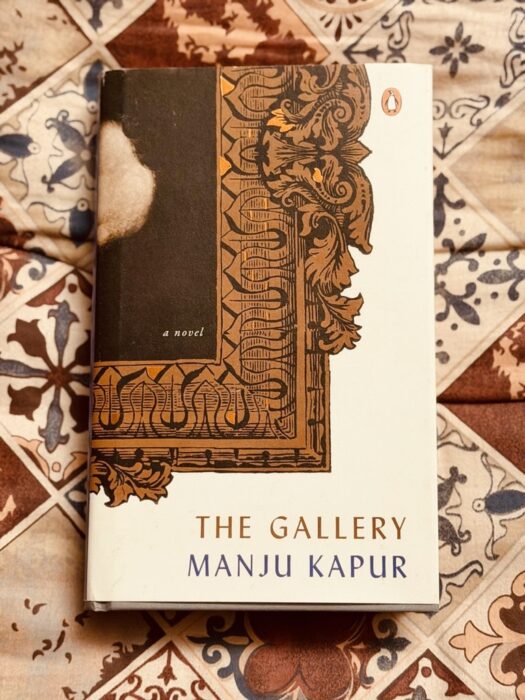
Revolving around the lives of four women (two mothers and their daughters) over a span of three decades, The Gallery by Manju Kapur is a book that shines for its mature writing and handling of feministic themes.
The lives of Minal, Maitrye (Matti), and their daughters Ellora and Tashi, respectively, bring forth the differences that can manifest in the day-to-day lives, aspirations and realities of two families separated by a socio-economic divide. Through a well-layered narrative, The Gallery, highlights the stark contrast in the way life unfolds for Matti, a native of a small village in Nepal, who follows her rather aggressive yet ambitious-in-his-own-way husband Krsna to Delhi as he aspires for a better life that he believes is rightfully his in Delhi. While Krsna and Matti (hired to be a caretaker for Ellora) live in the servants quarters with its meager belongings and constrained space, their masters live in the big house (Minal, who runs an art gallery and Alok, a successful lawyer). Minal treats Tashi, Krsna’s daughter on par with her own daughter, Ellora. Minal with her socialist outlook is always looking out for Tashi and Matti, and does her best to make sure that Tashi doesn’t feel left out and Matti remains financially independent.
The grey areas of the feelings that the characters navigate are captured beautifully. Krsna is relentless in his pursuit for extracting more from the rich family, constantly pointing out that there’s no necessity to show gratitude for what the rich do for the poor. He is constantly riled up about how easy it is for the privileged and often points out the highhandedness he feels that Alok and Minal show by helping Krsna and Matti, and Tashi. Matti, on the other hand, is deeply grateful for all that her memsahib does for her, yet, feels pangs of jealousy at the kind of lives the rich lead. This often ends up as comparisons between the kind of life that Ellora gets to live as compared to what her daughter, Tashi, gets to do. Minal, ever keen to help the family, out of a sense of duty and what doing right means, however, does express irritation about a “lack of gratitude” from the family for all that she and Alok do for them.
There is a constant comparative tension that is maintained between both families with starkly different economic and social conditions, but the beauty remains in how the story moves forward, gently carrying the dissonance and tension without breaking anywhere as the co-existence continues. Perhaps the most defining aspect of the novel is the relationship between Tashi and Ellora, especially with Ellora (an apt example of excellent upbringing by he mother, Minal) always watching out for Tashi, including her in everything, appreciating her and eventually helping her out in the most difficult times of her life. Tashi loves Ellora equally, but she often thinks of how Ellora has things easy. It is not difficult to see why Tashi is ambitious and adventurous the way she is and the experiences she sets herself up for. It’s a tale of ambition – of trying hard and striving to up her way of life, to belong to a place of higher standing and claim what she rightfully deserves as a human – not something that the society has assigned to her by way of her birth.
Another highlight is the relationship that the mothers share with their daughters; Matti’s dreams for Tashi are different, conditioned by her upbringing and background. Matti believes marriage is the most important aspect of a woman’s life, whereas Minal’s for her daughter are of a different order. She dreams of a highly independent life for Ellora, handling law and art side by side.
Minal as a mother and wife is crafted well – she is often plagued by self-doubt, especially in the initial stages of setting up her gallery. The persistent male gaze from her husband, often defining the success of her enterprise in his own terms, trying to tell her what she should be focusing on, is also something she has to live with. As a mother, Minal ensures that her daughter doesn’t discriminate based on someone’s social and economic status, is sensitive, helpful and an understanding human.
Alok comes across as a typical high-class male who is passive aggresive, projecting himself as this person who wants the best for his wife and daughter. He puts on the act of a husband who is “supportive” of his wife’s career, a man who says “I love you” without truly meaning it, and tries to act as if all is alright, that he cares for Minal when she works herself into a depressive state over the status of their marriage. Alok is a challenge Minal has to navigate on her journey to take certain important decisions about her life.
Each of Minal’s, Matti’s, Ellora’s and Tashi’s characters bring out how diverse and widely different the nature of women, their expectations from life can be; and so can be their opinions, viewpoints, happiness, constraints and experiences. Their lives are also demonstrative of how possessing the agency to do something or change one’s life depends on so many things, but especially on the socio-economic circumstances of one’s life.
Set in Delhi and Nepal, the pacing of the novel is well done; there is never a dull moment in the narrative, the descriptions especially of the locales in Nepal are enthralling. The world of art and galleries that the writer has built, coupled with her decision to showcase art as a means of expression and a business, delivers a fresh perspective.
Reading Manju Kapur’s book was a pleasure – a meaningful literary indulgence.