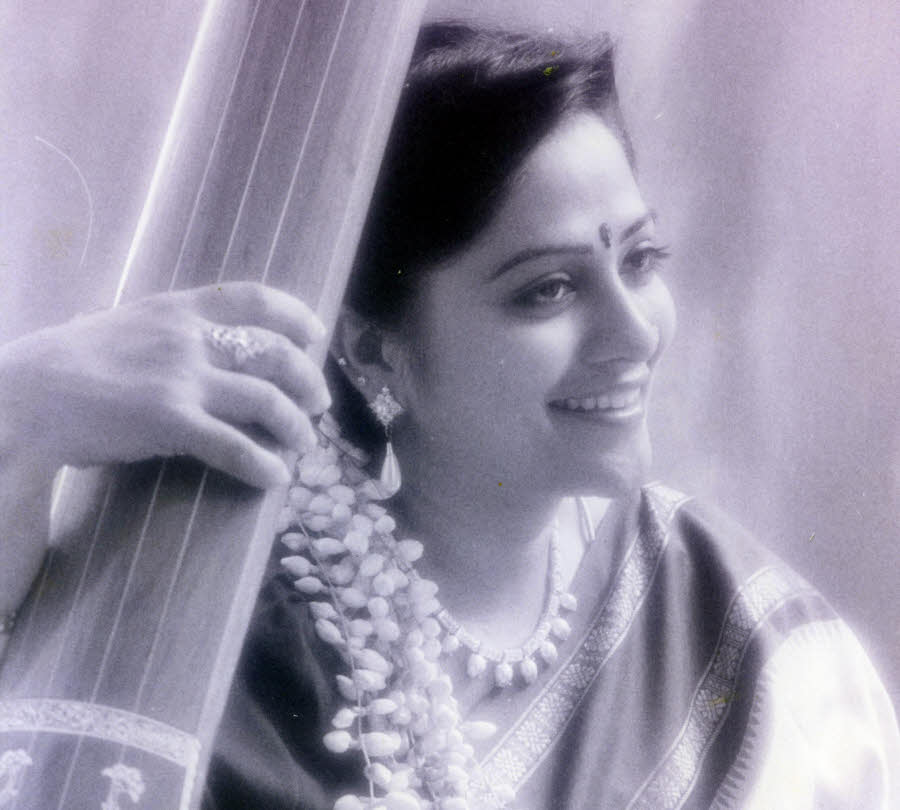
S.Sowmya is a popular and widely travelled Carnatic vocalist. She is a disciple of Sangita Kalanidhi Dr. S. Ramanathan as well as Smt. T. Muktha, of the legendary Brinda-Muktha duo. The desire to propagate the traditions of South Indian music worldwide led Sowmya to associate with her friend and vocalist Shashikiran, to establish Carnatica, an institution dedicated to music & dance instruction, archival, talent search and other related activities. Sowmya is a double postgraduate (Master’s in Chemistry as well as Indian Music) and was a top-ranked scholar at the Indian Institute of Technology, Madras, and the University of Madras. She discontinued her doctoral research program at IIT to concentrate on her music. In this interview, she talks to me about the qualities she expects in her students, what she has learnt from her revered Gurus and many more interesting aspects concerning music.
As a disciple of Dr.S.Ramanathan, what are some of the qualities and lessons that you have learnt from him?
I had the great opportunity to be with Dr.S.Ramanathan through ‘Gurukulavasam’. Therefore, I had the chance to learn not just the musical qualities but also observe his personal qualities as well. He was a great human being, a person who wouldn’t get angry, someone who was very patient with everyone and was absolutely humble and very soft spoken.
What about your other Guru, Muktha Amma?
She was also another person who was very child-like. Despite the pressures she had, she gave people what she had – music. She was one person who wanted everybody to learn and she taught the truly deserving people. It was a very child-like quality in her.
As someone who teaches music, what are some of the qualities you expect from a disciple wanting to learn Carnatic music?
One thing is dedication. There are many people who just come to spend some time and not for the sake of music. That’s something I don’t believe in and I don’t teach as well. Secondly, I also tell my students that they should listen to good music wherever it is; it is not just to their Guru that they should listen to. I tell them that they should listen to everyone and then create a unique style for themselves. I don’t generally permit recording in my class. I like my students to concentrate and learn in the class.
What do you wish to imbibe in your students?
The attitude – ‘art for art’s sake’ – that’s what I would wish to imbibe.
We would like to know more about the workshops you conduct. What do you focus on in these sessions?
It depends on the need or the specific requests that are put forth. I have conducted workshops on Varnams, on Manodharmam singing and on Krithis; for instance Devi Krithis for Navarathri. The workshops are generally for kids. But there have been certain occasions where I have done workshops for students at school and college levels as well. I have also done workshops for the ‘rasikas’. These are open to the general public.
Do you think music can be a means to teach the society something – in the sense create awareness about social issues?
Why not? Music was one of the important means of communication earlier. It has always played a great role. In fact, when music was not devotional, as was during the Tholkappiam and Sangam literature periods, it used to be a tool for communication between people and between rulers of kingdoms. There were musicians who travelled places, bridging the gap. And later, there were many patriotic songs that were composed to instill a sense of patriotism in the public. So, music has always been a very integral part of the sociological evolution of the Indian society. That way, today, many of the social problems including health related issues are being presented in the form of plays with a musical background. I am just giving you a tip of the iceberg. A lot more is being done.